Example 4: I = \int_C \frac{dz}z where C = 2e^{i\theta} and 0 \le \theta\le 2\pi. We cannot use the argument from earlier example because the antiderivative does not exist along the whole interval (regardless of branch cuts). We can try to split up C into C_1 and C_2, the left and right halves of the circle. Then, I = I_1 + I_2 where I_1 and I_2 are the integrals along C_1 and C_2 respectively.
On a domain D = \mathbb C \setminus \{\mathbb R_{<0} \cup \{0\}\}, \operatorname{Log} is a primitive for 1/z on C_1 \subset D. The previous lecture’s theorem tells us that I_1 = \operatorname{Log}(2i) - \operatorname{Log}(-2i) = \pi i (recall, \operatorname{Log}(z) = \ln |z| + i \operatorname{Arg}z). Note that this agrees with our corollary from lecture 19.
For I_2, on D' = \mathbb C \setminus \{\mathbb R_{>0} \cup \{0\}\}, 1/z has a primitive such as \operatorname{\mathcal {Log}}z = \ln |z| + i \operatorname{\mathcal {Arg}}z where 0 \le \operatorname{\mathcal {Arg}}z\le 2\pi. Note that C_2 \subset D'. By the theorem, I_2 = \operatorname{\mathcal {Log}}(-2i) - \operatorname{\mathcal{Log}}(2i) = \pi i (being careful to use our modified argument function).
Therefore, I =I_1 + I_2 = 2\pi i. We can conclude that \int_C z^n\,dz = \begin{cases} 0 & n \in \mathbb Z \setminus \{-1\},\\ 2\pi i & n = 0. \end{cases} for any circle C centred at the origin and positively oriented (counter-clockwise).
§50 (8 Ed §46).
Theorem. Let C be a simple closed curve in \mathbb C. If f is analytic on C and its interior, then \int_C f(z)\,dz = 0. Remark: The converse does not hold. Consider \int_C z^n\,dz with n = -2, -3, \ldots which is not analytic at 0 for any circles around 0.
Proof. Prove for a rectangle, then approximate the contour C these squares. The interior cancels and the outer edges approach the integral.
M-\ell estimate: (This forms a key step of the proof.) Suppose f is continuous on a contour C, given by z = z(t) and a \le t \le b. Then, there exists M such that |f(z)| \le M for all z \in C (by extreme value theorem in \mathbb R). So, \begin{aligned} \left|\int_C f(z)\,dz\right| &= \left|\int_a^b f(z(t))\,z'(t)\,dt\right| \\ &\le \int_a^b |f(z(t))|\,|z'(t)|\,dt \\ &\le M \int_a^b |z'(t)|\,dt = M\ell \end{aligned} where \ell = \ell(C) is the arc length of C.
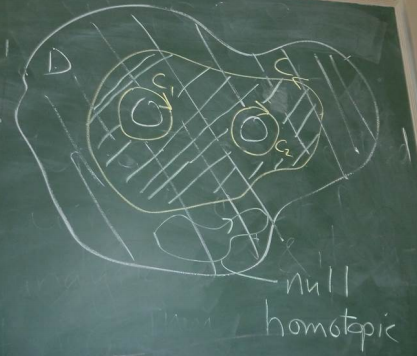
Recall (?) that a domain D is simply connected if for every simple closed contour C in D, it holds that \operatorname{Int}C\subseteq D. Roughly speaking, this means that D has “no holes”. That is, all simply closed contours are null homotopic.
If D is not simply connected, it is multiply connected.
Theorem. If f is analytic on a contour C, as well as on C_1, \ldots, C_n \subset \operatorname{Int}C and on the interior of the domain bordered by C_1, C_2, \ldots, C_n, and C, C_1, \ldots, C_n are all positively oriented, then \int_C f(z)\,dz + \sum_{j=1}^n \int_{C_j}f(z)\,dz = 0. Note that positively oriented means the that while traversing the contour, the region is on your left. This is particularly important for the orientation of C_1, \ldots, C_n.
Visually,